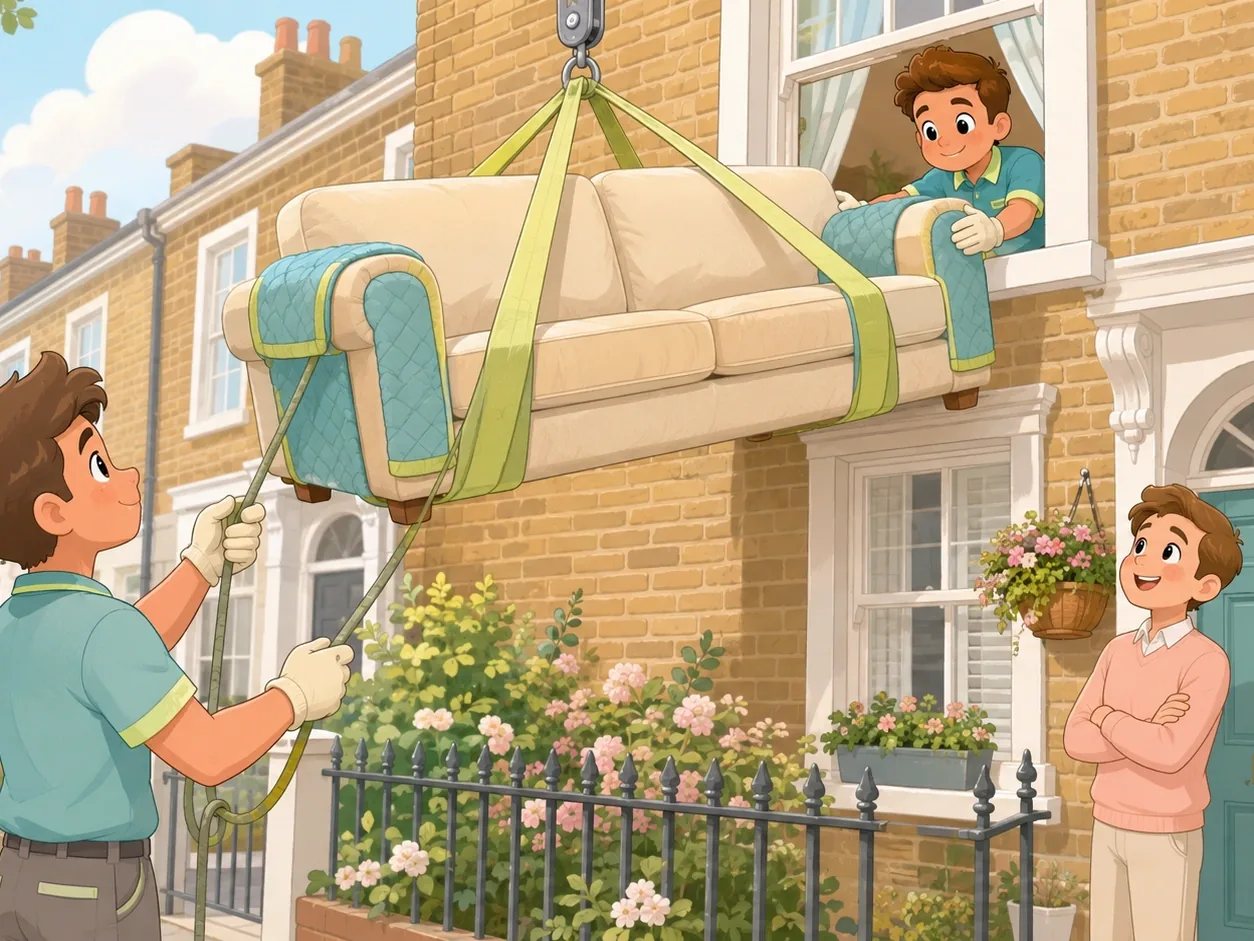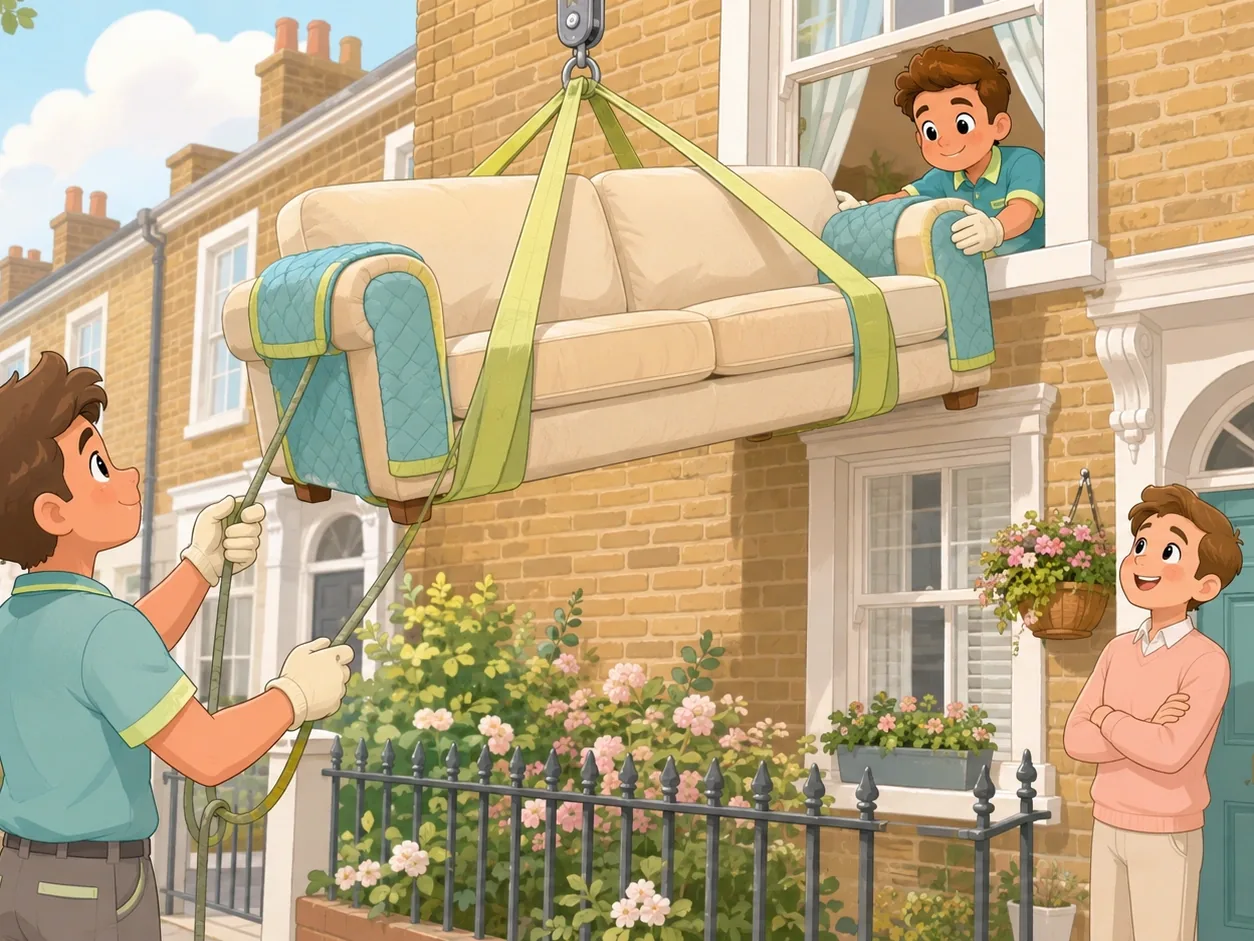
The short answer
Plan the route before the equipment
Do not book a hoist from the sofa size alone. Check the full internal route, removable parts and alternative entrances first. If those routes fail, send measurements and access photos for a specialist assessment, obtain any building permission, and agree the method and price in writing.
- Measure the sofa and the complete internal route before treating external lifting as the answer.
- Send clear photos of the item, stair turns, target opening, building exterior and street-level working area.
- The safest route may be carrying, professional dismantling, or a specialist lift after an access review.
- Confirm landlord, freeholder or building-management permission before booking exterior work.
Inside this guide
What you will be able to decide
01How to check whether the sofa can use an internal or alternative route.
02Which measurements and photos make a remote assessment more useful.
03How carrying, dismantling and specialist external lifting compare.
04Which access, permission and equipment factors shape the final quote.
05What a properly planned move should confirm before work begins.
“A good access plan starts with the route, not the equipment. Measure first, then choose the least complex safe method that fits the property.”
Alpha Movers specialist access team
Start with the internal route
A difficult staircase does not automatically mean the sofa needs an exterior lift. Check the full route from the vehicle to the final room, including communal doors, lift dimensions, landings, ceiling height and the angle needed at every turn.
Look for removable feet, detachable modules and alternative entrances. A side gate, rear door or professional dismantling plan may solve the access problem with less complexity.
Measure the pinch points, not just the door
Record the sofa at its widest fixed points. On the route, measure the narrowest width, available height and turning space. A doorway can be wide enough while the turn immediately behind it is not.
Build a useful measurement and photo pack
A useful first assessment needs scale and context. Share the sofa dimensions, floor levels and a short sequence of the internal route. For a proposed exterior route, include the target opening from inside, the same opening from outside, the full elevation and a wide street view.
Mention fixed obstacles such as railings, canopies, trees, cables, basement voids and restricted pavements. The mover may still need more information or a site assessment before confirming a complex job.
Related reading: How to Hoist a Sofa Through a Window or Balcony and Furniture Hoist Hire in London: Costs, Uses & Safety.
Compare carrying, dismantling and hoisting
Choose the least complex safe route that works. A normal carry is usually simplest when measurements confirm clearance. Dismantling may suit modular or serviceable furniture. Specialist external lifting is considered when those routes are unsuitable and the proposed opening and working area support a planned operation.
Avoid forcing the item through a route that has already failed. That can damage upholstery, frames, walls, bannisters and communal areas without solving the access problem.
What affects a sofa-hoisting quote?
A written quote depends on the actual item and site, not a generic floor count. Important inputs include dimensions and construction, the target opening, building height and layout, the external working area, parking or access controls, permissions and the equipment and crew needed for the agreed plan.
Alpha Movers publishes a starting price of £150 for sofa hoisting. Treat this as an entry point only. Ask the written quote to identify what is included and which changes—such as an incomplete item list or different access—would require re-pricing.
Confirm building and street requirements
Ask the relevant landlord, freeholder, managing agent or concierge whether exterior work is permitted and what documents or notice they require. Do not assume that access to a balcony or roof gives permission to use it for the operation.
Share parking restrictions, estate gates, loading bays and pedestrian conditions early. These details can affect whether the proposed working area is usable and how the move is scheduled.
How a safer lifting plan is agreed
The Health and Safety Executive says lifting operations involving lifting equipment must be properly planned by a competent person, appropriately supervised and carried out safely. Its work-at-height guidance also emphasises planning, supervision, competence and suitable equipment.
For the customer, the practical test is whether the provider can explain the proposed route, required access controls, property protection, responsibilities and circumstances that would stop or change the work. A confident guess is not a plan.
Prepare the item and property for move day
Clear the agreed internal areas, remove loose cushions and personal items, and keep children, pets and visitors away from the working zone. Follow the provider’s instructions on windows, balcony furniture and access to shared areas.
Before work starts, confirm that the item and route match the written scope. After placement, inspect the sofa and nearby property areas promptly and record any concern while the team is present.
When replacement may be the better choice
Compare the specialist quote with the sofa’s condition, value and future usefulness. If the piece is worn, inexpensive or likely to create the same access problem later, a modular replacement may be more practical.
For a high-value, sentimental or nearly new sofa, a properly assessed specialist route may make sense. The decision should follow the access review and written price, not precede them.
Decision table
Compare the main sofa access options
| Route | When it may fit | What the quote needs | Key limitation |
|---|---|---|---|
| Normal carry | The measured item clears doors, halls and stair turns | Item size, floors, route photos and parking distance | A single tight turn can make the route unworkable |
| Professional dismantling | The sofa is designed to separate or can be safely reduced | Construction details, labels and reassembly requirement | Not every frame can be dismantled without damage |
| Specialist external lift | Internal routes fail and a suitable window or balcony route exists | Dimensions, elevation, opening, working area and permissions | Requires a job-specific plan; photos alone may not settle complex access |
| Replace with a modular sofa | The existing item is low value or every safe route is disproportionate | Replacement and disposal costs compared with the specialist quote | You give up the original piece |
Balanced decision
Benefits and trade-offs of exterior access
Where it helps
- Provides an option when measured internal and alternative routes are unsuitable.
- Can avoid forcing furniture around tight turns and damaging the item or property.
- Lets the crew plan protection, access control and responsibilities before move day.
What to allow for
- Needs more planning than an ordinary carry and may require building permission.
- Street layout, the target opening and safe equipment positioning can rule out a proposed route.
- A complex lift may cost more than dismantling or replacing a lower-value sofa.
Save before you enquire
Sofa-hoisting quote checklist
These details help the team assess the route and explain what still needs confirmation.
- 1
Measure maximum length, depth and height; note removable feet, arms or modules.
- 2
Measure doors, hallway pinch points, stair turns, landings and lift interior.
- 3
Photograph the proposed window or balcony from inside and outside.
- 4
Show the building elevation, pavement, parked vehicles, trees, cables and other obstructions.
- 5
Ask the landlord, freeholder, concierge or managing agent what written approval is required.
- 6
Share loading restrictions, estate rules, gates and the distance from the vehicle.
- 7
Confirm the method, included protection, price assumptions, exclusions and cancellation terms.
Illustrative example — not a customer testimonial
Illustrative planning scenario: an upper-floor London flat
Typical managed apartment building
A large sofa clears the main door but cannot rotate around the final stair turn. The resident is considering an upper-floor window without yet checking the opening or management rules.
The resident supplies exact measurements and paired internal/external photos. The mover compares safe dismantling with an external route and asks the managing agent to confirm permissions before pricing the final scope.
The viable route, responsibilities and quote assumptions are agreed before moving day, avoiding a failed arrival and an improvised decision on site.
Services and evidence
Useful links and official sources
See Alpha Movers’ service scope and request an access review.
Alpha MoversFurniture dismantling and assemblyCheck whether reducing the item is a better route than exterior lifting.
Alpha MoversCurrent pricingReview published starting prices and what information is needed for a quote.
Official guidanceHSE: Lifting operations and equipmentOfficial overview of planning, supervision and safe lifting operations under LOLER.
Official guidanceHSE: Working at heightOfficial guidance on planning, supervision, competence and suitable equipment.
Official guidanceHSE: Manual handling at workOfficial guidance on avoiding and assessing hazardous manual handling.
The practical next step
Measure, photograph, then confirm
The right result is not automatically a hoist; it is a route that has been measured, assessed and agreed before move day. Start with the internal route, gather the photos and permissions, then ask for a written scope covering the item, access, protection and price.
Clear answers
Frequently asked questions
Alpha Movers sofa hoisting typically costs from £150 to £280. That is a guide range, not a fixed price: the floor level, the size and weight of the sofa, the width of the window or balcony opening, street access, any permissions and the agreed method all affect the written quote. Send photos of the sofa, the opening and the street below to get an accurate price.
Only when the measured opening, the approach and the outside working area all support a safe plan. The window or balcony must be wide enough once opened or removed, and there must be clear, safe space below to control the lift. Photos help with the first check, but complex jobs may need a closer assessment before the hoist is confirmed. Measure the sofa and the opening first.
Sometimes that is the better option. If the sofa is designed to come apart, such as a modular or corner sofa with removable arms or backs, professional dismantling is often simpler and cheaper than an external lift. It needs checking first, though, because some frames are not designed to separate and reassembly must be done properly. Send photos of the sofa's joints and underside so we can advise.
Often, yes. Managed blocks, rented homes and leasehold flats may need approval from the landlord, freeholder or managing agent before any external lifting work, and some ask for insurance documents or a method statement. Ask the concierge or managing agent early and keep the permission in writing. If the hoist needs space on the road, a council parking suspension may also be needed.
No, do not try to hoist a sofa yourself with ropes or improvised equipment. HSE guidance says lifting operations that use lifting equipment must be properly planned by a competent person, appropriately supervised and carried out safely. A falling sofa can seriously injure people below and damage the building. Book a trained team with the right equipment and insurance, and let them plan the lift properly.
Send both postcodes, the sofa's measurements and photos of the sofa, the internal route, the window or balcony you want to use, the full front of the building and the street-level working area. Add the floor level, parking arrangements and any permission notes from your landlord or building manager. With that information, we can say whether hoisting is suitable and give you a written quote.